


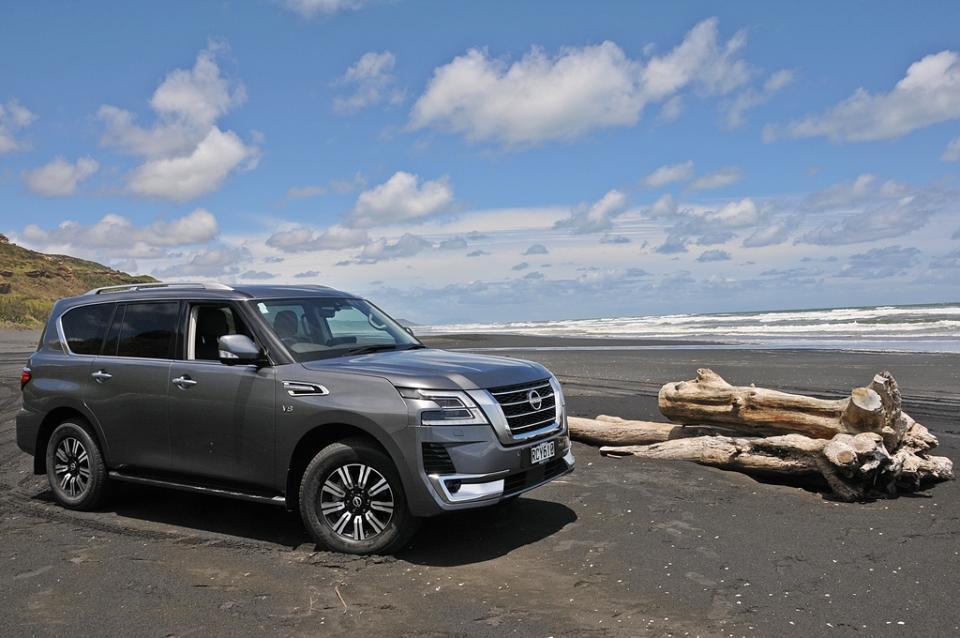
It’s come a long way, and done a lot of work. The Nissan Patrol has been on the road (and off the road) since 1951.
Back in the day it was available as either a short-wheelbase (SWB) three-door or a long-wheelbase (LWB) five-door chassis. The first one was a three-speed manual. Down the years, it’s been petrol powered, diesel powered and turbodiesel powered.
In its current Y62 iteration, Patrol has been designed to cope with all types of terrain, and to be able to tow up to 3500kg with ease. That’s on the upper end of large SUV capability. Multi-axle trailers, toy haulers, caravans, all towed in air-conditioned comfort.
When it comes to extra-large family SUVs that can tow 3,500kg, handle themselves off-road, and take care of everyone’s daily needs, there few options – the Ineos Grenadier, Toyota LandCruiser 300 Series and the Nissan Patrol.
In Australia, where the Patrol recently celebrated an 8000-unit sales year, 65 per cent of Patrol owners are under the age of 50, showing that the biggest audience for this vehicle is families with two, three or more children seeking adventure in the great outdoors.
This thing is one of the few SUVs available in New Zealand with a V8 engine. Its quad-cam, variable valve timing (valve lift and duration) VK56VD engine delivers 298kW of power at 5,800rpm and 560Nm of torque at 4,000rpm, with 90 per cent of torque available from 1,600rpm. The transmission is a nine-speed torque converter unit well capable of towing the maximum load at highway speeds all day.
Moving something this size around roads and tracks does come at a cost – in this case 16.2l/100km.
The Patrol also features Hill Start Assist and has a helical limited slip differential.
Patrol switched from ‘live’ axles to fully independent suspension front and rear with the arrival of the Y62 in 2010, but retains a full 3,500kg braked tow rating.
A notable addition to the chassis is the arrival of Nissan's Hydraulic Body Motion Control. Its cylinders replace traditional shock absorbers and anti-roll bars. The shock absorbers are linked by hydraulic lines and are able to pressurise each side of the vehicle to steady the ship. This action is speed-dependent so the shocks pressurise at road speeds to maintain a flat stance, but can soften up at low, off-road speeds to allow the suspension to droop to maximum effect.
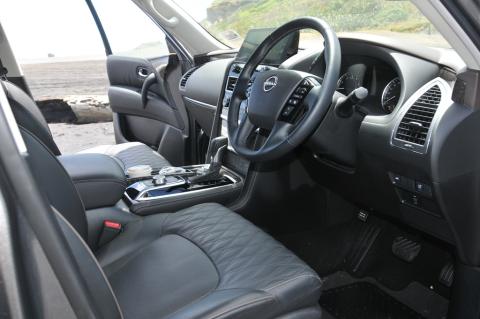
Patrol’s All Mode 4X4 drive system is controlled by a circular electronic switch cluster located behind the gear selector, allowing the driver easy mode selection for: sand, rock, snow or on-road driving, activation of the rear differential lock, VDC on/off and Hill Descent Control. The All Mode 4X4 controller also allows the driver to select between 4H and 4L.
The Patrol’s drive modes are accessed using a dial near the gear selector. Sand mode, for example, sharpens throttle response and adjusts traction control for better performance in soft terrain like dunes, working in 4H (high range) for general sand driving and 4L (low range) for getting unstuck or steep climbs.
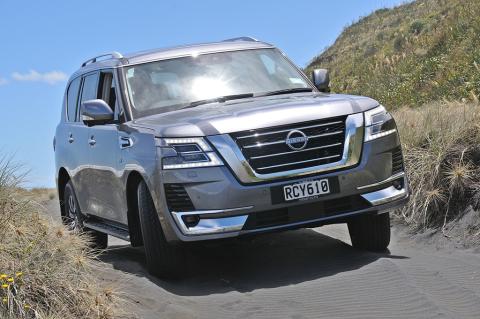
Of the three Nissan SUVs we’ve tested this month, the Patrol is the one that retains the brand’s longstanding offroad prowess. It arrived on a set of 265/70R18 Bridgestone Dueller all terrain tyres. This wheel/tyre combo equates to a 33-inch tyre, meaning a more aggressive offroad 33 will go right on. Aussies can fit 35s with an aftermarket two-inch suspension lift. We’re not sure many Kiwis will get into that 35-inch stuff, but there are a few Y62s running around with M/T 33s on aftermarket rims.
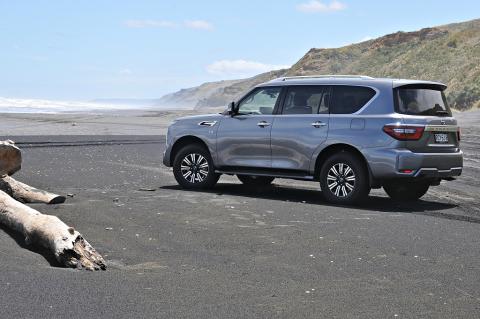
Tipping the scales at almost 2.8 tonnes and measuring 5175mm, this is a big SUV, and its helpful 360-degree camera system is a real boon when parking in tight urban spaces. We tested that in a couple of trips to the Manawa Bay mall at Auckland Airport. The camera view-points and high resolution made reversing into park spaces actually very painless.
The 2025 Nissan Patrol is a big step up from what was offered over the last few years, even after the 2024 update, which brought a new infotainment screen offering wireless Apple CarPlay and Android Auto for the first time.
The 2025 model has a new dashboard layout that includes the 12.3-inch infotainment screen first introduced to the US market four years ago, and it's paired with a 7.0-inch digital instrument cluster.
The previous screen and cluster were 10.1 and 5.0 inches respectively. While big screens aren’t the be-all and end-all, they do resonate with buyers these days, especially younger ones with families who want all the latest technology (namely Apple CarPlay and Android Auto), so it is a major selling point.
In the cabin, the emphasis is on comfort. Fair enough, it’s appropriate for an SUV selling for just over $118,000. This is very much a ‘designed’ environment, with lots of glossy grey sections contrasting with leather trim on dash, doors and console.
Front seats are in two-tone leather with heating/cooling functions and two memory settings on the driver’s seat.
The second-row seating has a 60/40 split-fold with manual recline and fold function and centre armrests. The third row has 60/40 split-fold with manual recline and fold function.
There are privacy screens on the second-row side windows and a sunroof. A 13-speaker Bose sound system, Android Auto and Apple Car Play and Bluetooth hookup to phones take care of sounds while driving.
As noted last time we drove one, the Patrol has a large and useful centre cool box, very much a practical feature on long hot summer drives.
Patrol is, of course, a seven-seater. We did climb into the third row of seats to prove they are adult-sized, though as always that row of seating is best reserved for the kids if long distance trips are planned.
With the third row in place, the Patrol still offers a respectable 467-litres of space, and if both rear rows are folded down that number increases to a massive 2623-litres.
There’s a full suite of safety and driver assist systems required for decent safety ratings, though the Y62 doesn’t actually have an ANCAP or NCAP rating. There are the usual, expected standard systems including emergency brake assist, forward collision warning, lane departure warning and intervention, blind sport warning and rear cross traffic alert.
Driven
Patrol is the senior of the three Nissan SUVs we’ve driven this month. It’s very clearly the biggest and heaviest, and that is communicated when it hits the road. Progress from a stop works best when the throttle is smoothly applied, which translates the serious torque available into a smooth surge forward.
The engine’s beat is muted and respectable. Grown-ups will like that, especially on long trips. Others may will find themselves wondering if it’s possible to delete a muffler or two.
The Patrol’s seven speed torque converter automatic transmission is also pretty smooth; there are paddle shifters for those who appreciate choosing the gear themselves. Manual gear selection and low range is a superb combination when offroad, as is hill descent control or one of the selectable drive modes.
At first, it seems the Patrol is at its best on longer trips – gravel roads or tarmac – and when hauling big loads like a dual axle caravan or motorsport trailer. For those who might be buying for such work, or simply for commuting, we do recommend tackling some more adventurous offroad stuff, because this is where the Patrol’s legendary all-terrain prowess will shine through. It’s worth it.
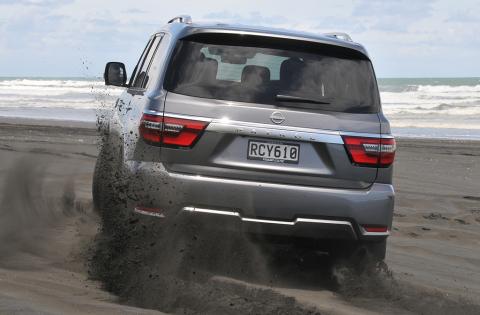
Then we took it out for a drive at Karioitahi. Once we’d been breath-tested by the police on duty and shown them we’d applied for a beach driving permit (which arrived the following Wednesday!), we were good to go. It was not far from high tide, and the sand was pretty sloppy in parts. No problem for the Patrol. Select the Sand mode and away we go. Running in 4-Lo beats the mushy bits, and the transmission’s seven speeds let us get up on top of the sand. We also tried the paddle shifters and can say manual shifting the big SUV in the sand is pretty good. Held gears keep the Patrol in its torque ‘sweet zone’ which is rather high compared to a diesel. Driving this way retunes the operator’s right foot and ear pretty quickly into petrol V8 mode.
It’s fair to say the offroad drive revealed the Patrol’s DNA links to Patrols of the past – in a good way.
While it does feel old-school mechanically and technologically in some areas, its robust, traditional SUV appeal, V8 grunt, and practicality for families and touring make it a compelling choice, especially given its strong value against competitors like the Toyota Land Cruiser. The LC300 is substantially pricier at a similar spec level, doesn’t offer a V8 engine, and there aren’t a lot of them coming into the country.
Nissan Australia reckons resale values of the Y62 will go through the roof going into 2026 as customers realise the last V8-powered Patrol ever made will be all but impossible to get by the end of the year.
That means another potential ownership benefit for the soon-to-be-retired Y62 Patrol is its resale value.
Conclusion
The Y62 Patrol still has the goods for those who like to get offroad. We can see it appealing to owners looking to do epic summer camping trips towing a suitably tough offroad caravan, which the Patrol will hardly notice.
It’s also supremely premium-spec inside to satisfy the owner’s ‘inner CEO’ on commutes in and out of the city. That commanding drive position is as handy in traffic as out in the beach or on a beach adventure.
For those who love a V8 rumble, it’s the most affordable way to get that sound in a proper 4WD SUV.
For those who have more than a couple of kids, it’s a great way to lug them around the back-blocks or to Saturday sport.
And even with all seven seats filled, there’s an impressive amount of cargo space available.
 ,
,  ,
,  ,
,  ,
,