


It’s an intriguing proposition.
An established and innovative truck manufacturer drives back into New Zealand’s bustling ute market with an all-new ‘midsize-plus’ ute that aims to challenge the established big utes from Cannon, MG and LDV.
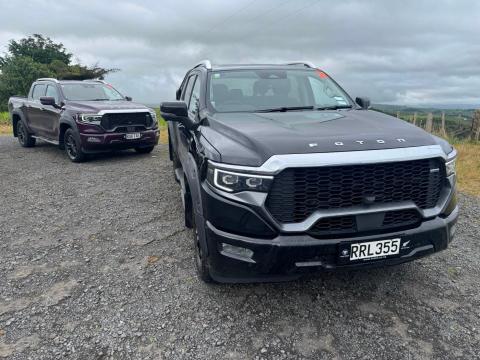
Foton’s Tunland is a good-looking addition to the only sector of the automotive market that currently seems under-populated.
The Tunland started life as a compact ute in 2011. It was a simpler product in a simpler market and its price was a strong incentive for Kiwis wanting to get in on the growing ute culture that would soon begin to dominate New Zealand’s roads.
At the time, it was part of a growing wave of Chinese automotive product being exported to world markets.
The original Tunland was sold in New Zealand from 2014 by Ateco. That changed in 2017 with Anglesea Vehicle Distributors, part of the multi-brand car-retail giant Ebbett Group. Tunland left the market in 2019 when Foton ended right hand drive production.
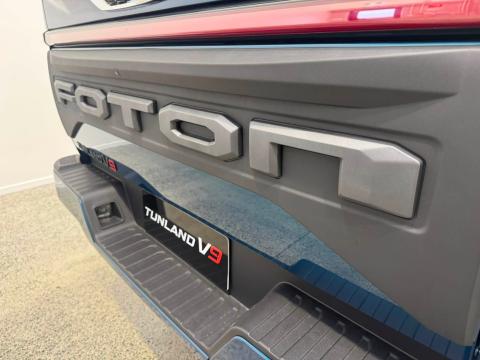
From 2023 the Mars 7 and 9 ‘midsize-plus’ utes have been sold under the Tunland nameplate outside of China as the Tunland V7 and Tunland V9 respectively.
Now, the new utes have arrived in New Zealand.
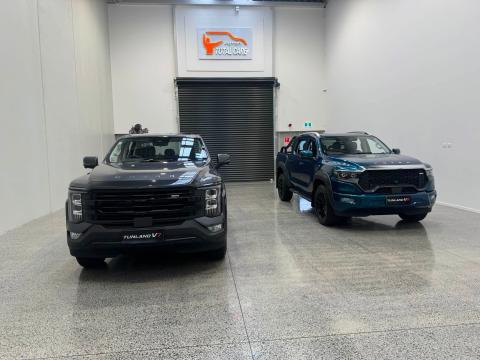
We get a rear-wheel-drive V7, a 4WD V7 and a 4WD high-spec V9.
The latter is a taller and – thanks to its wheelarch flares – slightly wider vehicle. It is clearly pitched at families and those looking for a high-spec, smart-looking ute for recreation and work.
The V7-C 4x2, V7-C 4x4 and V9-S 4x4 share the same 120kW/450Nm powertrain.
There are different front end styling treatments, for the different versions but the main body panels are shared, as is the cabin design.
Underneath, there’s a key difference. The work-focussed V7 has a live rear axle and leaf springs to cope with loads right up to its payload limit of 1155kg (RWD) and 1050kg (4WD). The V9 runs a live axle with coil springs (smoother ride) and has a maximum payload of 995kg.
From the start, Tunland has benefited from Foton’s joint venture partnerships. The original Tunland had a strong but noisy Cummins diesel engine, Getrag transmission and BorgWarner 4WD system.
The all-new V7 and V9 take a step up with Foton’s own turbodiesel, mild hybrid drive and ZF eight speed automatic transmission.
Tunland’s AuCan engine was co-developed by Foton and respected UK automotive engineering consultancy Ricardo. It’s quiet and refined, light years away from the older version’s Cummins diesel. All versions of Tunland share the same drivetrain, and the engine makes 120kW at3,600rpm; 420Nm between 1,500 and 2,400rpm.
The three-version range clearly offers ‘working’ V7 and ‘recreational’ V9 utes, the latter leaning heavily into SUV-style high spec levels.
Midsize-plus utes are a useful half-size up on traditional utes like Ford’s market-leading Ranger and Toyota’s Hilux but aren’t as massive as the Dodge Ram and Chev Silverado pick-ups that top the market. They have the midsize class benchmark 3,500kg braked tow rating and fit New Zealand’s roads better than the big American vehicles.
Tunland is bigger than its midsize-plus rivals. It’s 5617mm in length, well up on the likes of the GWM Cannon Alpha (5445mm).
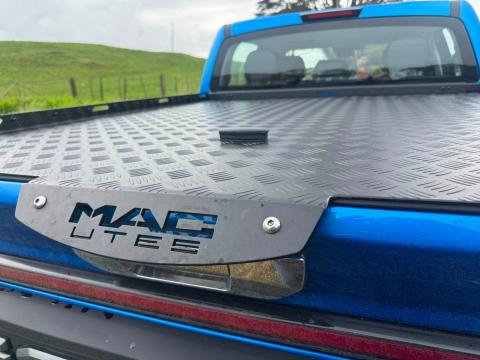
Its tray cargo area is 1,577mm long, 1,650mm wide and the sides are 530mm. With a 1,250mm gap between wheelarch bulges, it comfortably fits a standard pallet – for those looking for a work ute, that’s important.
Foton NZ chief executive Roger Jory says the ute’s size is a key feature: “larger than the traditional utes, yet smaller than the heavy duty American trucks. It’s designed to hit a sweet spot: the right size, the right capability and the right price."
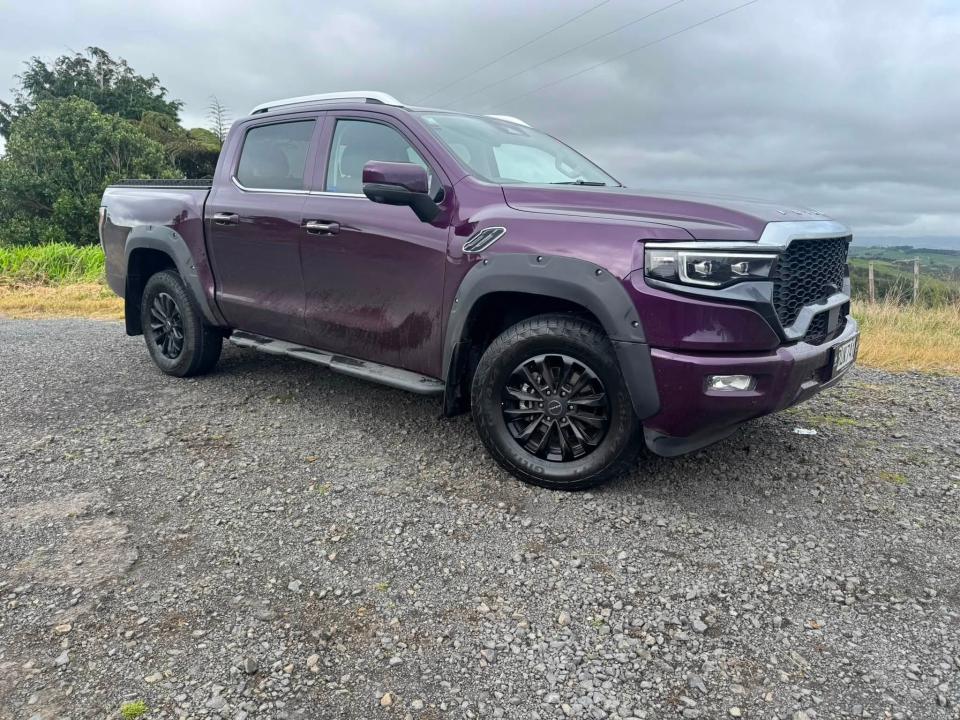
It’s easy to get tired of the run of the mill black, white and silver exterior colours of utes on our roads. Foton offers some bold colours in addition to the usual white, black, silver and grey: Tahitian Blue, Aurora Green, Inferno Red and Charger Purple. One of the drive fleet at launch was in Charger Purple and we like it a lot.
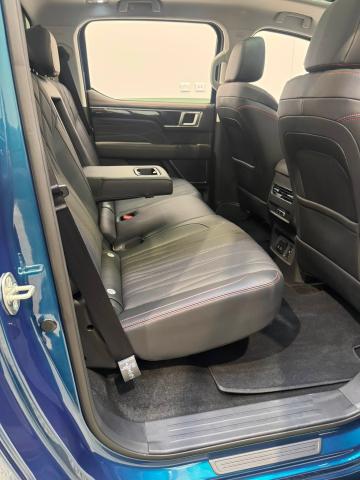
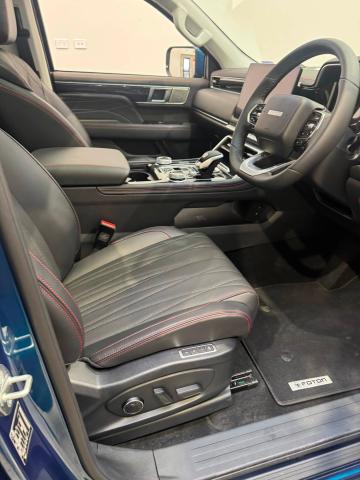
Inside, all versions are of course spacious and pleasant environments. Black synthetic leather upholstery is standard, though Foton NZ is also offering brown as an option.
Like all modern utes, the Tunland has a comprehensive package of safety-oriented ADAS systems, including a driver awareness camera on the driver-side A-pillar. Like most of its rivals, these can be custom set and even turned off. Unlike most of its rivals, Tunland will remember the preferred settings after it’s switched off. Bliss. We don’t know its ANCAP rating yet – and rumour has it that being able to set the vehicle’s ADAS the way the driver prefers may make a five-star rating hard to achieve.
We got to grips with the tarmac and gravel road handling on the drive out to Raglan and back, and the coil-sprung V9 was slightly ahead in terms of both comfort and grip. That said, the leaf-sprung V7 didn’t embarrass itself with excess chop or axle tramp over gravel road corrugations.
There’s not much to set the V7 ahead of the V9 for offroad work except that leaf-sprung rear end – but we’ll have to wait for a longer drive opportunity to say for sure.
The steering is three-way adjustable: sport, comfort and light. We would use the Comfort setting for everyday duties.
The 4WD models share the same part-time 4WD system. They can run in 2WD for better economy, but our pick is the 4WD auto setting – it can be used on tarmac and dirt without winding nasty torque shudders into the transmission and axles and automatically adjusts the torque allocation per wheel. A handy selectable driver instrument display in the main instrument screen displays torque allocation in real time.
Beyond 4WD auto there are traditional high and low-range settings and diff locks.
There are six modes that alter the behaviour of the drivetrain: eco, standard, sport, sand, mud and snow.
 ,
,  ,
,  ,
,  ,
,  ,
,