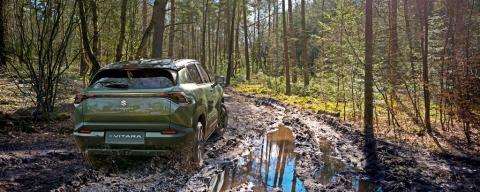



The timing was accidentally exquisite. They couldn’t have known it, but Suzuki managed to launch its first EV right in the midst of the USA-Iran-Israel oil war with its accompanying surge in fossil fuel prices and hints of panic-buying and petrol-hoarding.
The e-Vitara was shown to motoring media this week at the spectacular Boom Rock farm outside Wellington.
It arrives here in the midst of continued uncertainty over fossil fuels, and it’s poised to sell out from launch, with Suzuki’s allocation for the year sitting well under 500 vehicles.
The e-Vitara is now the only Vitara – there won’t be fossil-fuelled stablemates coming later. There are FWD single-motor and 4WD dual-motor versions. Suzuki expects to sell about three FWD models to every AWD. The FWD e-Vitara starts at $56,990, while the all-wheel drive variant starts from $64,990. Suzuki New Zealand currently has an introductory offer across both models which knocks $2,000 off the price.
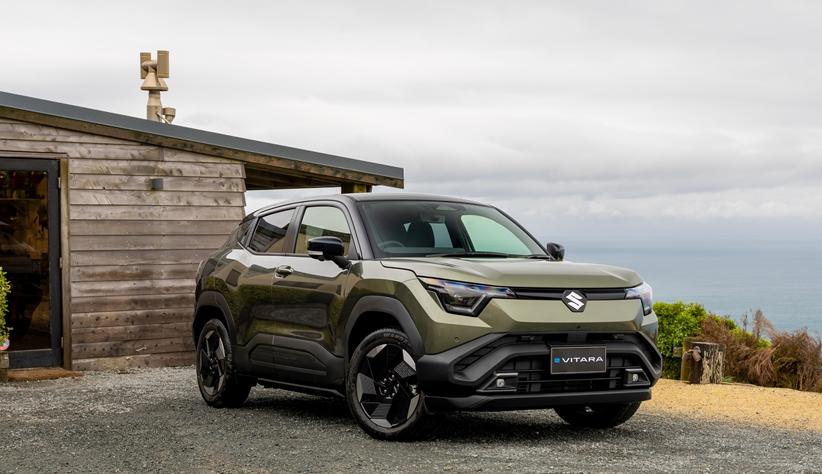
Visually, the new model retains a hint of the previous model, but of course it’s all new and is built around BYD’s clever Blade battery, which is built into the floor as an integral part of the chassis. FWD and AWD variants are powered by a 61kW battery. The front-wheel drive model has up to 426km of range, while the AWD model has 395km.
At 4.2-metres long, the e Vitara is 100mm longer than the outgoing Vitara, and slightly shorter than market rivals like Kia’s EV3 SUV. There’s less overhang than the outgoing model, with all four wheels pushed out to the corners.
This vehicle has a relatively hefty 1700kg kerb weight for the FWD model and more than 1900kg for the AWD. Despite weighing around 500kg more than the outgoing ICE Vitara, the e Vitara feels impressively agile on tarmac.
Where the old Vitara was manufactured in Japan, the e Vitara comes from Suzuki Maruti, which is the brand’s Indian arm. This isn’t the first time New Zealand has seen an Indian-built Suzuki, either, with the five door Jimny and the recently introduced Fronx coming from the same factory.
Inside, it’s very much a Suzuki family member. The upholstery mixes black cloth with mid-brown synthetic leather accents. Glossy piano black covers the centre console, and the gear selector requires a push-and-turn movement to move from neutral into drive or reverse.
A 10.1-inch infotainment screen in the dash centre offers all standard infotainment modes and has wireless Apple Carplay and Android Auto connectivity. The driver’s display is a customisable 10.25-inch digital cluster.
There’s a 7-speaker Infinity sound system with subwoofer, 12-colour ambient lighting
The driver’s seat has 10-way electric adjustability, while the front passenger makes do with manual seats. Both front seats are heated.
The rear bench will slide fore-aft to accommodate passengers or cargo.
A sunroof offers light and air to the front seat passengers.
The e-Vitara is also a shared project with Toyota, confusingly enough. Though Toyota and Subaru are joint venture partners in their debut EV projects (BZ4X and Solterra respectively), the e-Vitara is also sister to a thing called the Toyota Urban Cruiser. That’s a name that does describe what the e-Vitara is designed for really.
But that’s no bad thing given what most ‘crossover’ SUVs are used for.
Our pick, of course, is the AWD version, which is more expensive (of course) but more sure-footed. Though the AWD cars at the launch were running Maxxis Razr or Nexen all terrain tyres, they arrive in showrooms on urban-influenced MRF tyres.
This is a practical, city-friendly EV with modern styling and a focus on affordability and efficiency. In AWD format, it’s also a great way to get away for a weekend at the snow or enjoying a break at a backblocks lodge.
While it’s not a hard-out bush-bashing offroader, it has a place in the Kiwi market and will appeal to a range of buyers – we suggest mostly those who’d previously have bought the previous version, with some conquest sales among people who are shopping for an SUV with green credentials who might otherwise be looking at something from the throngs of such vehicles emerging from China.
Driven
So what’s it like?
From the front seats, the e-Vitara has a typical EV ‘feel’. With the battery mounted into the floor, the front-rear weights distribution is always going to be good, and with that weight low down it’s pleasingly calm in the sidehill sections of the offroad course. The weight, of course, is greater than an ICE SUV the same size, and it makes its presence known on scrabbly downhills, where hill descent control is a handy means of managing pace and direction.
The all-terrain tyres are a help, though the course set out for us could probably have been tackled on the standard-spec MRF road tyres. Unless, of course, the rain that threatened us all day actually fell.
First, though, we tried an FWD version on Boom Rock’s wee tarmac track, which features two blind brows, a left-right-left set of corners, and a long sweeping right after the start-finish zone.
Punting a 1.8-tonne SUV around a track like this doesn’t relate much to on-road driving, but it did provide a controlled environment in which to get the feel of brakes and suspension.
The e-Vitara handles predictably, turning into corners smoothly and with slight body roll. Like most EVs, it has un-nerving acceleration away from rest and at low speeds, and there’s no tyre squeal unless the driver’s gone beyond the vehicle’s dynamic capabilities.
Onto the dry grass and dirt of the offroad track. Boom Rock has a strange dual-personality character. It’s either brilliantly sunny, blue sies and puffy clouds (it wasn’t) or there’s a weird wispy misty cloak of cloud over the place (it was). Rain threatened, but never delivered.
The e-Vitara did deliver. Nobody had to have two runs at the uphills, the vehicle’s transmission management computers holding wheelspin to a minimum. Downhills that had the bonnet staring out into the mist were simple and safe using hill descent control.
In the afternoon, media paired off to tour back to the city, and we made sure we got into one of the AWD vehicles. At local road and then open road speeds the e-Vitara was calm and composed, though the bloke we travelled with didn’t like the A/T tyres. Too smeary in corners. We were less worried – drive to the conditions and be mindful of what the tyres are capable of.
This is not a hard-out bush basher, as we’ve mentioned. But it’s an accomplished chassis and drivetrain that will deal calmly with dirt roads, wet muddy tracks and more. Not a bad way to sneak away to the snow either.
Suzuki’s designers and engineers have produced a vehicle that is well matched to the needs of its prospective owners – and taken a bold step into EVs - with the AWD version of particular note.