


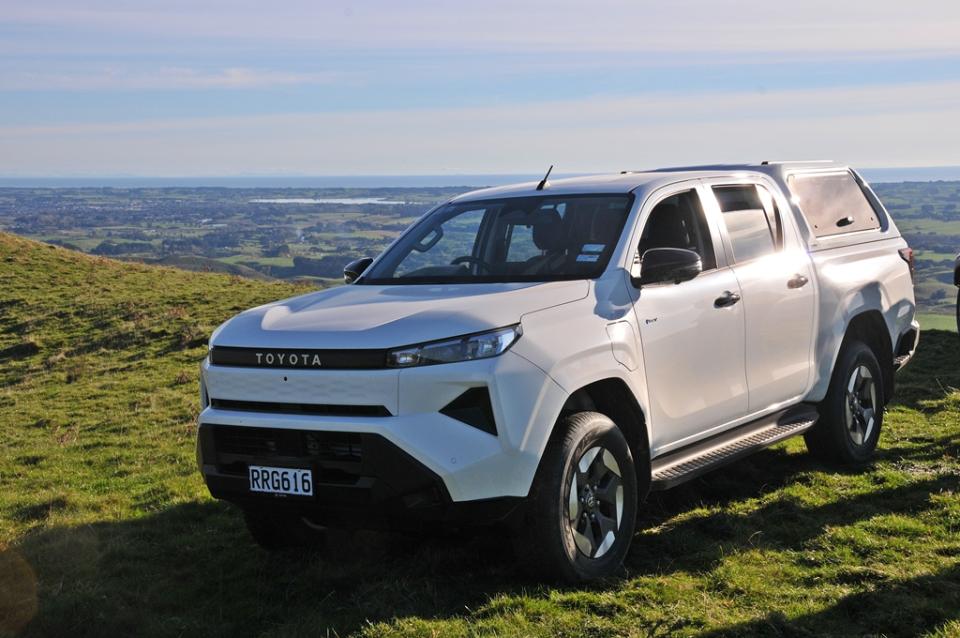
In late May, Toyota New Zealand officially launched its first-ever fully electric Hilux alongside the new ninth-generation diesel and hybrid models. The all-electric Toyota Hilux BEV is the long-awaited zero-emissions version of the iconic utility vehicle and it will likely appeal strongly to government departments, utility companies, large corporates wanting a work-capable ute that aligns with environmental policies. All BEV variants come standard with an all-wheel-drive transmission powered by dual electric motors that produce a combined 144kW, and they will be available in two exterior colours - Glacier White and Ash (grey).
The electric drive is powered by a 59.2 kWh battery giving up to 315km range; using a proper wall charger at base gives a 10 to 80 per cent charge in around 30 minutes.
To accommodate the electric powertrain, the BEV models feature their own suspension system with unique frame reinforcements, strengthened MacPherson strut front suspension and a leaf spring/De-dion rear suspension which accommodates the rear electric motor.
According to Toyota, the Hilux BEV is "designed for roles that allow for overnight charging at a home base or depot", and features a braked towing capacity of 2000 kg and an unbraked capacity of 750 kg. While the all-electric powertrain is an important new addition for fleet and government buyers, the turbodiesel and turbodiesel mild hybrid versions remain central to the Hilux range.
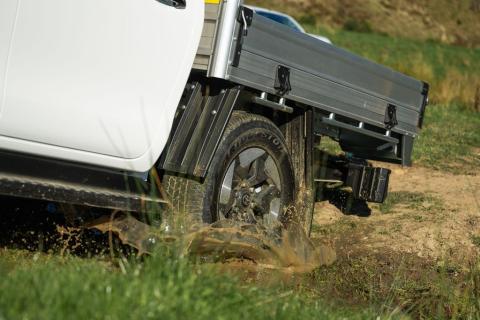
Driven at the launch event near Palmerston North, we put the BEV Hilux through its paces on steep climbs, slippery wet grass, loose terrain and technical sections. Like the rest of the Hilux family, the BEV went everywhere with a level of control that was supremely easy.
In fact, the BEV made much of the drive even more smooth than the mainstream diesel versions.
No gearbox juggling, no hunting for the right ratio or stopping to engage low range or a diff lock. Just instant, seamless torque and point-and-go simplicity.
This is a significant sell-point for corporate or government buyers – the BEV will make it much easier for employees to reach remote areas, carry out work, and get home safely.
The BEV climbed banks with less fuss (well, tyre scrabble) that the diesels – and all in near silence.
Its drive computers managed power and torque to each wheel more precisely than a human driver could.
There is more chop to the ride than the MHEV versions, but that’s mainly when operating without a payload on board.
The initial purchase price for the BEV version is of course higher than the mainstream turbodiesels, and that may divert private buyers and tradies back toward the latter.
We did wonder what Crumpy and Scotty would have made of it, but in terms of on-road manners and off-road ability, the BEV is definitely 100 per cent a Hilux.
The pure-electric Hilux is sold exclusively in double cab configurations (either cab chassis or wellside) across three trim levels:
- SR Double Cab Chassis, $79,990
- SR Double Cab Ute, $81,990
- SR5 Double Cab Ute, $85,990
 ,
,